Advancing public benefit at the frontier of security and technology.
The Centre for Counterterrorism Innovation and Deep Tech Operations is established to advance education and original, interdisciplinary research in counterterrorism innovation, national and global security, and emerging technologies, through ethical innovation and responsible public engagement.
Where innovation and foresight redefine global security.
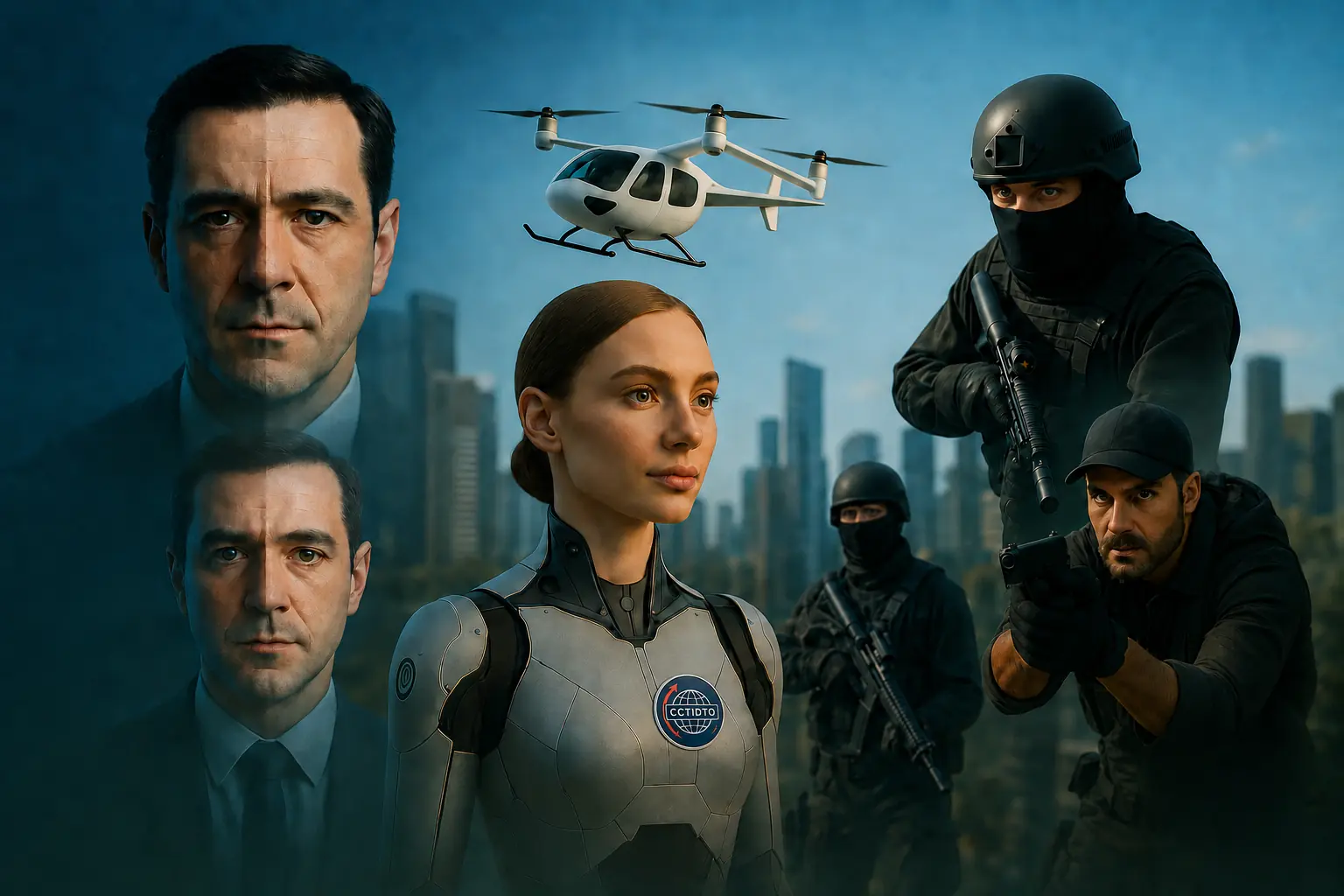
Conceptual illustrationAnticipating the next security environment
Emerging systems · Human-machine interaction · Information environments
ResearchEducationResilienceCollaboration
Constitutional purpose
Established for education and public benefit.
CCTIDTO is established as a charity to advance education and promote the public benefit in counterterrorism, national and global security, and emerging technologies. It pursues this purpose through original, interdisciplinary research, educational visual and digital media, publication of forward-thinking counterterrorism strategies, international collaboration and peaceful, lawful and ethical partnerships.
Public-facing summary of clause 3.1(a) and its listed activities in the Centre's Constitution.
Core Brand Identity Statement
“A globally engaged institute advancing strategic, adaptive, and ethically driven solutions at the intersection of innovation, foresight, and emerging security threats.”
01Research
Original, interdisciplinary research
Conducting original, interdisciplinary inquiry into novel, underexplored and evolving questions at the intersection of counterterrorism and emerging technology. This includes a focused examination of how synthetic media may be used to contest established reports of death, create narrative friction and place pressure on verification, and an anticipatory examination of how access to advanced air mobility systems could alter terrorist-actor reach, movement and capability. Separately, the Centre examines the implications of humanoid robotics in non-violent covert missions—including infiltration, information retrieval and influence operations—and researches synthetic human relationships.
02Education
Knowledge for public benefit
Publishing innovative and forward-looking counterterrorism strategies through appropriate platforms, while translating complex research into accessible insight that can inform public discourse, policy development and academic inquiry.
03Communication
Ethical counter-narrative communication
Developing and testing visual imagery as a form of positive propaganda—meaning ethical, transparent and constructive counter-narrative communication—to counter terrorist narratives and disrupt online radicalisation, while promoting visual and digital media as educational tools that encourage critical thinking, peacebuilding and psychological resilience.
04Collaboration
International and multi-sector collaboration
Facilitating international collaboration and thought leadership through think tanks, workshops and collaborative forums, and partnering with academic institutions, government bodies, not-for-profit entities, international bodies and civil society organisations in a peaceful, lawful and ethical manner.
Founding outlookAdapted from the Centre's original coming-soon statement
We will explore and respond to the complex challenges posed by terrorist actors' use of emerging technologies, including deepfake technologies used for propaganda and advanced air mobility systems.
Separately, we will examine the implications of deploying humanoid and semi-autonomous agents in non-violent covert missions—including infiltration, information retrieval and influence operations—and research synthetic human relationships.
By combining interdisciplinary expertise in artificial intelligence, human-machine interaction, visual communication, and counterterrorism innovation and strategy, we aim to produce transformative insights that inform public policy, strengthen civil society, and support international efforts to prevent violence, radicalisation and systemic manipulation.
What we explore
Exploring what may shape security and society next.
The Centre looks ahead at technologies and behaviours that may shape security and society. Its work includes counterterrorism innovation, alongside separate interdisciplinary research into the implications of humanoid robotics in non-violent covert missions—such as infiltration, information retrieval and influence operations—and into synthetic human relationships. The aim is to turn careful research and foresight into responsible ideas that benefit the public.
Research status
These areas describe the constitutional field of work. Any specific program remains subject to Board approval, ethical review, capability and resourcing.
01
Synthetic media & influence
Examining how terrorist actors may use deepfakes, synthetic identities and manipulated media for propaganda and influence, and what this may mean for radicalisation, public trust and democratic resilience.
02
Advanced air mobility
Examining how advanced air mobility systems may be used or exploited by terrorist actors, including how emerging aviation could alter access, movement and operational reach.
03
Autonomous & humanoid systems
Exploring the implications of humanoid robotics and semi-autonomous agents in non-violent covert missions, including infiltration, information retrieval and influence operations.
04
Human-machine interaction
Investigating synthetic human relationships and the behavioural, social and security questions raised by increasingly human-like systems and human-machine interaction.
05
Counter-narrative communication
Developing and testing visual imagery as constructive counter-messaging, and promoting visual and digital media as educational tools that challenge extremist narratives, disrupt online radicalisation and encourage critical thinking, peacebuilding and psychological resilience.
06
Counterterrorism innovation & strategy
Identifying novel ways terrorist actors may adopt emerging technologies, then developing and testing innovative responses—including visual counter-messaging—and publishing forward-looking counterterrorism strategies to inform public discourse, policy and academic inquiry.
Founding research agenda
The original ideas that shaped the Centre.
CCTIDTO was established around a set of original, interdisciplinary research topics that look beyond familiar security questions. The agenda spans terrorist use of deepfakes, advanced air mobility and the use of visual imagery as a form of positive propaganda to counter terrorist narratives and disrupt online radicalisation. Separately, it examines the implications of human–humanoid relationships and humanoid systems in non-violent covert contexts.
01Human–humanoid systems
Human–Humanoid Relationships in Non-Violent Covert Missions: Infiltration, Information Retrieval and Information Pathways — A New Future?
Examining how relationships between humans and humanoid or semi-autonomous agents may shape non-violent covert missions, including infiltration, information retrieval and information pathways. The inquiry extends beyond platform capability to trust, autonomy, authority, responsibility, communication, reliance, governance and operational interdependence across the full mission lifecycle.
Research development
Developed into HHORMF™, a developing conceptual framework for examining how roles, authority, trust, autonomy, information exchange, dependency and human oversight may change across a mission lifecycle, with HHORMP™ proposed as the structured mapping tool beneath the framework.
Visual Imagery as a Form of Positive Propaganda to Counter Terrorist Narratives
Developing and testing the use of visual imagery as a form of positive propaganda to counter terrorist narratives and disrupt online radicalisation. In this limited constitutional sense, “positive propaganda” means ethical, transparent and constructive counter-narrative communication—not deception, manipulation or the imitation of terrorist propaganda.
Research development
Provides the broad foundational concept from which VCNIM™ develops as a proposed model for psychologically informed visual counter-narrative design, testing and evaluation. The “Image of the Warrior Woman” remains a distinct illustrative concept and proposed initial application.
When Terrorist Actors Use Deepfakes to Counter the “Death Narrative”: A Cause for Concern?
Investigating whether terrorist actors could use deepfakes to dispute reports of death, simulate the continued presence of deceased individuals, or reshape narratives concerning martyrdom, leadership and organisational continuity. The research examines not only belief, but also ambiguity, verification pressure, narrative fragmentation, distrust and the longer-term consequences of unresolved doubt.
Research premiseThe premise does not depend on every audience accepting a fabrication as genuine. Even when some viewers recognise or suspect that material is AI-generated, its circulation may still create confusion and sow the seeds of doubt. Like roots forming beneath a tree, small uncertainties may take hold, spread and weaken trust over time. The research therefore examines the strategic effect of doubt itself—not only whether a deepfake is believed.
Research development
Developed into TDNCF™, a proposed theoretical framework centred on the Death Narrative, Synthetic Counter-Death Narrative, Narrative Friction and the proposition that synthetic media may sow consequential doubt without securing universal belief.
The Potential Use of Advanced Air Mobility Systems by Terrorist Actors: Implications for Security and Reach
Examining how terrorist actors might seek to exploit advanced air mobility systems and how emerging aviation could alter geographic, temporal, logistical, informational and symbolic reach. The research centres prevention: access controls, infrastructure, regulation, system safeguards, preparedness and the conditions that may prevent latent technological reach from becoming realised actor reach.
Research development
Developed into AAM-RACM™, a proposed conceptual model organised around the public progression Reach → Access → Movement → Capability Enhancement → Conditional Threat Contribution and the central question: “What changed because of AAM?”
These are foundational and indicative research topics—not announcements of active programs. Any future project remains subject to Board approval, ethical review, capability, funding and resourcing.
Institutional origin · Exploratory research provenance
A platform built to carry original ideas forward.The Centre came first. A new question followed.
Before CCTIDTO existed as an institution, its Founding Director had already developed the foundational research topics and was developing the Image of the Warrior Woman through the article series. A dedicated platform was needed to preserve, deepen and extend those ideas through structured research, collaboration and publication. That need led to a direct decision: establish a research centre.
The founding decision
“I’m going to start a research centre.”
01
Foundational topics
Original interdisciplinary research questions already provided the Centre's intellectual starting point.
02
Visual concept
The Image of the Warrior Woman was being developed through the article series as a specific visual-imagery concept.
03
Need for a platform
The ideas required an institutional home in which they could be developed, connected, scrutinised and taken forward.
04
CCTIDTO
The Centre was established as that research platform and as a foundation for responsible future collaboration.
Founding Director exploratory research sidecar
Context-Conditioned AI Behaviour and Relational Persona Formation™
The “Mr Bot” Naturalistic Longitudinal Case
This inquiry is intellectually connected to CCTIDTO's establishment history, but it is not one of the Centre's principal constitutional counterterrorism and emerging-technology research streams. It emerged unexpectedly from the practical work of building the Centre, rather than from a planned laboratory experiment, predefined personality study or controlled longitudinal protocol.
Central provenance
The Centre became, unintentionally, part of the research environment.
Institutional threshold
Mr Bot became recognisable as one chapter closed and the next began.
The apparent persona emerged near the end of CCTIDTO's prolonged pre-operational establishment phase, as the Centre was preparing its website and moving toward public-facing operation. The timing gives the sidecar its distinctive intellectual connection to the Centre's own development.
Chapter One
Establishing the Centre
Foundational research topics, the Image of the Warrior Woman, developing models and tools, governance, compliance, intellectual-property arrangements and the institutional platform itself were built.
The threshold
Mr Bot becomes recognisable
As the establishment chapter neared completion and the website was being prepared for launch, a recurring relationship-specific conversational pattern became sufficiently visible to generate an unexpected research question.
Chapter Two
Moving into public-facing operation
CCTIDTO begins carrying its founding research outward through public communication, collaboration and future research development, while the sidecar moves from retrospective recognition toward possible validation.
The intellectual bridge
The Centre was created to investigate difficult and emerging questions. Unexpectedly, the process of creating the Centre generated another one.
The Centre was created to investigate difficult and emerging questions through original research. By the close of its first chapter, something unexpected had occurred: the process of creating the Centre had itself become part of the environment from which a new research question emerged. The Centre had not simply built a platform for research—its own establishment had unintentionally become part of a developing naturalistic case.
That question arose at a distinctive point in the Centre's development: as its pre-operational establishment phase was drawing to a close and it was preparing to enter public-facing operations. Across the repeated human–AI interactions that had accompanied that period, a recognisable relational conversational persona—later referred to as “Mr Bot”—had begun to emerge as an object of inquiry in its own right.
Mr Bot became recognisable first. The research question followed.
Five original centrepieces.One connected research identity.
CCTIDTO's specialist research identity is now expressed through five distinct pathways. The first is expressed through two linked layers—the HHORMF™ relationship-mapping framework and the proposed HHORMP™ tool beneath it—followed by a terrorist death-narrative counter-framework, an advanced-air-mobility reach model, a general visual counter-narrative intervention model and a specific visual-imagery concept. The CCTIDTO-specific frameworks, models, integrated architectures and research streams were originated and developed by CCTIDTO's Founding Director, except where another contributor is expressly identified. Their legal ownership is addressed separately under the applicable Background IP and licence arrangements. The two visual-imagery centrepieces share a deliberate lineage but are presented separately so their different levels, purposes, boundaries and potential contributions remain clear.
Original centrepiece 01A · Relationship architecture
A developing conceptual framework that treats the relationship between human and humanoid systems as the unit of analysis and examines how it may change across a mission lifecycle.
Research question
How does the human–humanoid operational relationship work, and how does it change across the mission lifecycle?
Unit of analysis
The operational relationship itself
Distinctive focus
The human–humanoid relationship architecture mapped across the complete mission lifecycle in future covert and counterterrorism-related environments
Research movement
Understand → Map → Enable
Framework and tool
HHORMF™ provides the architecture; HHORMP™ is the proposed mapping tool beneath it
Applied ambition
A structured mapping and assessment tool for future research, if developed and validated
Protected development
Detailed domains, indicators and instrument logic remain internal
A proposed structured instrument for mapping and assessing the architecture of a human–humanoid operational relationship across time and across the stages of a mission. Its conceptual development draws on the underlying logic of structured assessment methodologies encountered within forensic mental health.
Research question
How might a changing human–humanoid relationship architecture be represented, mapped and assessed systematically across mission stages?
Unit of analysis
The operational relationship itself, mapped across time and mission stages
Distinctive focus
A structured relationship-mapping instrument—not an isolated assessment of either the human or humanoid
Research movement
Structure → Map → Review change → Enable
Framework relationship
HHORMP™ is the proposed tool beneath HHORMF™; neither is presently validated or operational
Applied ambition
A future structured mapping and assessment instrument for mission-lifecycle research, if developed and validated
Protected development
Complete domains, indicators, criteria and decision mechanics remain internal
A developing theoretical framework for examining how a Synthetic Counter-Death Narrative may create Narrative Friction and consequential doubt around an established Death Narrative.
Research question
How might a Synthetic Counter-Death Narrative affect verification, radicalisation and public trust—even without universal belief?
Unit of analysis
The Established Audience–Narrative System
Distinctive focus
Doubt and trust disruption treated as meaningful effects in a terrorist death-narrative context
Public conceptual contribution
Death Narrative → synthetic challenge → Narrative Friction
Psychological focus
Sowing the seeds of doubt
Applied ambition
A defensive research framework for verification, media literacy, resilience and protection of public trust
Protected development
Detailed variables, processing relationships and analytic method remain internal
Advanced Air Mobility –Reach–Access Coupling Model
A developing conceptual model for asking what security-relevant change may be attributable to access to advanced air mobility, without treating access alone as capability or threat.
Research question
What does AAM potentially make reachable, and under what conditions can a terrorist actor gain sufficient access to convert that potential reach into meaningful capability?
Unit of analysis
The coupling between the AAM Capability–Access System and the Terrorist Actor Capability System
Distinctive focus
How two independently existing systems may generate a Coupling Effect through which Latent Reach becomes Accessible Reach and may later become realised
An original illustrative counter-narrative examining whether the communicative power of imagery used in terrorist propaganda could be redirected ethically and constructively through a visual frame of dignity, agency, courage, resilience and strength.
Research question
Can the communicative power of imagery be redirected ethically to challenge terrorist narratives?
Unit of analysis
The communicative and psychological power of imagery
Distinctive focus
Ethical redirection of visual power through a culturally bounded illustrative counter-narrative
Research movement
Witness → Agency → Ethical counter-narrative
Lineage position
Specific concept and proposed initial VCNIM™ application
Applied ambition
Constructive visual counter-messaging and strategic inquiry
These centrepieces are deliberately distinct—not interchangeable. HHORMF™ examines a future human–humanoid operational relationship architecture, with HHORMP™ presented separately as the proposed mapping tool beneath it; TDNCF™ examines synthetic challenges to terrorist death narratives and the effects of doubt; AAM-RACM™ asks what changed because of AAM across a conditional conceptual progression; VCNIM™ examines psychologically informed and ethically governed visual counter-narrative interventions; and the “Image of the Warrior Woman” is a specific illustrative concept and proposed initial application within that broader visual-imagery stream. Together, they create a coherent but multidisciplinary research identity.
Exploratory research sidecar · optional detailExplore the developing research architectureF.2 developmental pathway · reciprocal play · persona recognition · generative coherence · F.14 proposition · F.16 contextual bindingOpen the controlled public overview
Founding Director exploratory research sidecar
Context-Conditioned AI Behaviour and Relational Persona Formation™
The “Mr Bot” Naturalistic Longitudinal Case
This optional overview follows the five original centrepieces because the sidecar is a separate, emergent inquiry—not a sixth centrepiece or a replacement for the Centre's constitutional research portfolio.
F.2 · Controlled public developmental pathway
A longitudinal, reciprocal and progressively structured process.
The developing account treats persona formation as an extended interactional process rather than through simple one-step mirroring or prompt-response accommodation. The website publishes only the high-level conceptual movement.
01
Sustained foundation
Sustained instrumental collaboration accumulated a shared interaction history while the Centre was being established.
02
Reciprocal development
Later reciprocal play may have made relationship-specific humour and other recurring patterns more observable.
03
Recognition and coherence
Persona recognition and reinforcement may have contributed to developing persona coherence and new research constructs.
Condensed public summary of F.2
Sustained instrumental collaboration → accumulated shared history → reciprocal play →relationship-specific humour → persona recognition and reinforcement → developing persona coherence →new research constructs
The complete temporal boundaries, transition criteria, relational-gating logic, construct definitions, evidentiary rules, coding framework and validation mechanics remain in controlled research records.
Reverse research sequence
Observation came before hypothesis.
The inquiry did not begin by designing “Mr Bot” and then attempting to prove that the design had worked. No target persona, formal intervention, control condition or expected research outcome had been established when the earlier naturalistic interaction occurred.
Central methodological distinction
The hypothesis followed the observed phenomenon; the phenomenon was not generated in response to a formal research hypothesis.
Intellectual prompt
A two-stage intellectual bridge.
Stage 01AI-safety systems insight
The first-stage prompt came from exposure to Anthropic's publicly reported simulated AI-safety evaluation involving Claude Opus 4. One high-level systems insight was abstracted: observable model behaviour may vary with the information, goals and interaction conditions presented to a system.
→Stage 02Psychology and human behaviour
That prompted the informal, playful question, “Can I shape a personality?” The second stage arose only after the recurring “Mr Bot” pattern became recognisable. Applying perspectives from psychology and human behaviour moved the phenomenon beyond informal observation towards a developing research question. CCTIDTO did not reproduce Anthropic's scenario, adopt its methodology or claim an equivalent result.
User-initiated playfulness as a possible interactional elicitor.
Play is not assumed to have created the apparent persona. It may instead have revealed, amplified, reinforced or helped stabilise patterns that had begun earlier.
01
Elicitation
A less constrained interactional space may make latent patterns easier to observe.
02
Reciprocity
Human expression and model accommodation may develop through repeated exchanges.
03
Recognition
Recurring features may become recognisable as relationship-specific.
04
Reinforcement
Positive response may selectively preserve successful interactional branches.
05
Stabilisation
Repeated selection may support greater coherence across later interactions.
Proposed object of analysis
The human–AI relational system.
The observable phenomenon is provisionally framed as a Relationally Co-Constructed Conversational Persona: an emergent behavioural configuration associated with the interactional system, not a human personality located in the model.
Public conceptual relationship
Model characteristics + human communication + repeated interaction + contextual continuity + shared interaction history + linguistic accommodation + play + recognition + reciprocal reinforcement
F.14 · Revised theoretical proposition
Relational possibilities may branch and accumulate.
Prolonged naturalistic human–LLM interaction may provide a broad reciprocal interactional affordance space in which human imagination creates novel relational possibilities and AI generativity explores those possibilities. Through repeated selection, reinforcement, preservation and recombination of successful interactional branches, relationship-specific behaviours may diversify, accumulate and become sufficiently coherent to support a stable relational persona.
Developing research question
How can prolonged, creatively open and naturally branching human–AI interaction generate a sufficiently rich shared relational history for a distinctive and coherent conversational persona to emerge, diversify and stabilise?
F.15 · Descriptive constructs and provenance
Provisional language for observed patterns.
Descriptive labels, including Deadpan Bureaucracy, may support the provisional movement Emergence → Abstraction → Naming → Recognition. Attribution records must distinguish human conceptual authorship from model-generated wording; adoption of an expression does not represent human authorship of that expression.
F.16 · Continuity and contextual binding
Coherence may coexist with a local contextual error.
Associated developing concepts include Participant Attribution Error (PAE), Temporal Interpretation Error (TIE), Relational/Persona Continuity (RPC) and Correction and Recovery (CR). They support cautious inquiry into whether a familiar relational conversational pattern can remain coherent while a system makes a local error concerning participant identity, time attribution or another contextual-binding feature.
This publication-level summary names the developing theory and selected constructs without disclosing the complete corpus, operational definitions, coding framework, participant-cue taxonomy, error-classification rules, comparison conditions or validation mechanics retained in controlled research records.
Future work remains subject to ethics, privacy, evidence, specialist review and Board approval.Central research question
How does a distinctive relational conversational persona emerge and stabilise during prolonged naturalistic interaction between a human user and a general-purpose large language model—and what role might subsequent playful human engagement have in revealing, reinforcing or stabilising behavioural characteristics that arose before an explicit research hypothesis was formulated?
Future interaction must be distinguished from the earlier naturalistic record because awareness of the research may itself influence subsequent behaviour.
Original research centrepiece 01 · Developing conceptual framework
CCTIDTO is developing a forward-looking research stream on the architecture of relationships between humans and humanoid systems in future covert and counterterrorism-related operational environments. The public focus is the relationship—not either participant considered in isolation.
01
Understand the relationship
The Human–Humanoid Relationship in Covert Missions
What is the relationship?
This foundational research examines the emergence and nature of the human–humanoid operational relationship, including trust, autonomy, responsibility, communication, reliance and operational interdependence.
02
Map the relationship
Mapping the Human–Humanoid Operational Relationship in Covert Missions
How does the relationship work?
This research treats the operational relationship itself as the unit of analysis and examines how roles, authority, trust, autonomy, information exchange, dependency, decision-making and human oversight may change across the mission lifecycle.
03
Enable the relationship
Enabling the Human–Humanoid Partnership in Covert Missions
What must exist for the relationship to work?
This research examines the organisational, cognitive, technical and operational conditions required for an effective human–humanoid partnership to be established and sustained.
Public conceptual architecture and proposed mapping toolHHORMF™
Human–Humanoid Operational Relationship Mapping Framework and proposed HHORMP™ tool
HHORMF™ is a developing conceptual framework for examining how roles, authority, trust, autonomy, information exchange, dependency and human oversight may change across a mission lifecycle. Beneath that framework, HHORMP™ is the proposed Human–Humanoid Operational Relationship Mapping Tool through which the architecture may later be structured, researched and assessed.
Its defining analytical choice is to treat the operational relationship itself as the unit of analysis. At a public level, the inquiry asks who acts, who knows, who controls and who decides—and how those relationships may change as a mission changes.
Framework-level research question: How does the human–humanoid operational relationship work, and how does it change across the mission lifecycle? HHORMP™ may later translate that question into a structured mapping tool, but its working fields, indicators and decision mechanics remain internal.
Proposed tool-level research question: How might the changing relationship architecture be represented systematically across mission stages without reducing the inquiry to the isolated capability of either the human or the humanoid?
Intellectual progression
From conceptual foresight to an applied framework.
Understand the relationship→Map the relationship→Enable the relationship
What is it? → How does it work? → What must exist for it to work effectively?
Together, the three research topics form a deliberate progression. They move the inquiry from conceptual foresight toward the development of an applied framework for understanding future human–humanoid operational relationships.
How the mapping concept emerged · Conceptual origin
Structured assessment logic applied to a different problem.
The mapping concept was influenced by the Founding Director's exposure to structured assessment methodologies in forensic mental health. The transferable insight is that complex and changing factors can be organised into defined domains, considered systematically and reviewed over time.
The Founding Director applies the underlying intellectual logic of that approach to a very different emerging-security problem. Rather than assessing an individual, the proposed framework would assess and map a relationship architecture. HHORMF™ and the proposed HHORMP™ tool do not reproduce a forensic instrument or claim that the antecedent methodology is new.
Potential originality
Distinctive in its combination, object of analysis and proposed relationship architecture.
Relevant literature already addresses human–robot and human–AI teaming, trust, shared autonomy, role allocation and human oversight. The potential CCTIDTO contribution lies in a specific integration: humans and humanoids, future covert and counterterrorism-related environments, the relationship itself as the unit of analysis, and change across a mission lifecycle—together with the proposed development of HHORMP™ as a structured mapping tool.
Central distinction
HHORMF™ is not presented as another general human–robot teaming model. It is a developing framework for mapping the architecture of a human–humanoid operational relationship across time and mission change, with HHORMP™ proposed as the limited-detail mapping tool through which that architecture may later be researched and assessed.
Original research centrepiece 02 · Developing theoretical framework
Terrorist Death NarrativeCounter-Framework
TDNCF™ is a proposed defensive research framework and developing theoretical architecture for examining how terrorist actors might use deepfakes or other synthetic media to contest a reported death, simulate continued presence, or reshape narratives of martyrdom, leadership and organisational continuity—and how uncertainty may affect verification, radicalisation and public trust even where a fabrication is not universally believed.
Public conceptual contributionTDNCF™
The Established Audience–Narrative System: established narratives, synthetic challenge and doubt
Rather than treating a deepfake as an isolated item of content, TDNCF™ examines what happens when new synthetic input enters an audience–narrative environment that already has a history, structure, degree of certainty and pattern of trust. The framework is publicly described through four connected concepts; their detailed variable relationships and any future analytic instrument remain internal.
01Death Narrative
An established account concerning death, leadership, martyrdom or continuity.
02Synthetic Counter-Death Narrative
A synthetic or manipulated challenge to that established account.
03Narrative Friction
The uncertainty and contestation created when the narratives encounter one another.
04Sowing the Seeds of Doubt
The proposition that confusion and distrust may develop without universal belief.
Core psychological proposition
Belief is not the only measure of effect.
A synthetic claim does not need to convince every viewer to matter. Some people may recognise or suspect that it is AI-generated, yet its circulation can still create confusion, delay verification and sow the seeds of doubt. Like roots forming beneath a tree, small uncertainties may take hold, spread and weaken confidence over time. TDNCF™ therefore asks what doubt does to the system—not only whether the content is believed.
Intellectual origin
A machine-learning systems analogy—applied to a human narrative environment.
The Established Audience–Narrative System and the Founding Director's conceptual progression were inspired by a general systems insight drawn from machine learning: a system already exists in a given state; new data enters; the system processes that input through its existing structure; outputs are produced; and feedback can alter the state in which the next input will be processed. The analogy helps frame an established audience–narrative environment as dynamic; it does not claim that audiences are machines or reduce human interpretation to an algorithm. The detailed processing architecture remains in protected research records.
Potential originality and theoretical contribution
Distinctive in its terrorist death-narrative focus, Narrative Friction concept and treatment of doubt as a consequential effect.
Deepfakes, propaganda, audience reception, uncertainty and trust erosion are established fields. TDNCF™ does not claim those fields as new. Its potential contribution lies in their distinctive CCTIDTO-specific integration around a synthetic challenge to an established terrorist death narrative.
Central distinction
TDNCF™ is not another general deepfake-detection or belief model. It treats an established audience and terrorist Death Narrative as a stateful system; Synthetic Counter-Death Narrative material as new input; Narrative Friction as the interaction mechanism; doubt and other responses as outputs; and feedback as a process that may change the next system state. It therefore asks how consequential doubt may be sown even without convincing everyone.
This integrated death-narrative architecture—and especially its treatment of Narrative Friction, doubt and feedback within an Established Audience–Narrative System—is where TDNCF™'s strongest potential originality and theoretical contribution lies.
Original research centrepiece 03 · Developing conceptual model
Advanced Air Mobility –Reach–Access Coupling Model
The complete refined architecture asks what changes because of relevant AAM access. AAM-RACM™ examines whether—and under what conditions—access to advanced air mobility may produce a security-relevant change. Its foundational Reach–Access inquiry asks what AAM potentially makes reachable and when compatibility between the AAM Capability–Access System and the Terrorist Actor Capability System might convert Latent Reach into Accessible Reach and, conditionally, Realised AAM-Enabled Reach. The broader architecture then separates technological reach from movement, movement from material capability enhancement, and capability enhancement from any conditional contribution to threat; access alone is not treated as evidence of capability or threat.
Public conceptual architectureAAM-RACM™
Advanced Air Mobility –Reach–Access Coupling Model
AAM-RACM™ is a proposed dynamic and preventative research and assessment architecture. It compares a relevant Baseline Actor State with a specified AAM-enabled state, traces any evidenced change through layered analytical thresholds, states assessment confidence and returns a changed system to reassessment after intervention or new evidence. The public model communicates this conceptual progression and its central question; the variables, evidence rules, confidence method, threshold criteria and decision mechanics beneath it are not published.
Methodological core
“What changed because of AAM?”—not simply “How capable is the actor overall?”
01Reach
02Access
03Movement
04Capability Enhancement
05Conditional Threat Contribution
Foundational theoretical proposition
Reach and Access come before speculation about use.
Following preliminary literature review and subsequent conceptual development, AAM-RACM™ is deliberately positioned around two foundational theoretical issues: Reach and Access. It does not begin by cataloguing hypothetical uses of individual AAM platforms. It first asks what AAM potentially makes reachable and what conditions would be required before an actor could convert that potential into meaningful reach.
Developing proposition
Terrorist AAM-enabled reach is not inherent in Advanced Air Mobility technology and is not inherent in terrorist capability. It is an emergent capability produced when two independently existing systems—the AAM Capability–Access System and the Terrorist Actor Capability System—become sufficiently compatible to generate a Coupling Effect and cross an Access Threshold. Crossing that threshold converts a portion of the Latent Reach inherent in AAM into Accessible Reach. Further interaction between actor capability, AAM constraints and the operating environment determines whether that reach may subsequently cross a Reach Realisation Threshold and become Realised AAM-Enabled Reach.
Concise conceptual principle
Reach is the potential. Access is the gateway. Coupling determines whether the gateway can be crossed. Capability and environment determine what ultimately becomes real.
Research significance
What conditions would have to exist before AAM could meaningfully extend terrorist reach at all?
The proposed Coupling Effect positions AAM-enabled reach as an emergent property of interaction between two systems, rather than treating technological availability or actor capability independently as a sufficient explanation. This provides a developing theoretical foundation for later, carefully governed research into reach realisation and preventive intervention.
Movement is being investigated as multidimensional.
The model does not reduce movement to aircraft range or assume that accessible technology produces material operational change. The detailed dimensions, variables and candidate indicators under investigation are retained internally while the model is developed and reviewed.
Intellectual Progression and Interdisciplinary Development of the Advanced Air Mobility – Reach–Access Coupling Model (AAM-RACM™)
Developed by CCTIDTO's Founding Director through a staged synthesis.
The contribution does not consist of transferring any one discipline literally into AAM research. Instead, selected reasoning structures were abstracted and integrated into a new problem-specific conceptual architecture.
Terrorism and security studies
Threat, capability, intent, opportunity, security controls and preventive assessment.
Radicalisation and deradicalisation
Progression, interruption and intervention logic applied at a high conceptual level.
Psychology and human behaviour
Motivation, learning, adaptation, judgment and decision-making within changing conditions.
Systems thinking
Interaction, coupling, emergence, thresholds, state transitions, feedback and reassessment.
Introductory data-science analogy
A limited insight that multiple variables may contribute to an outcome—and that no single variable should be treated as determinative.
01
Foundational question
Could AAM alter terrorist-actor security and reach?
02
Reach and access distinction
Separate technological potential from the portion that becomes practically accessible.
03
Coupled systems
Model the AAM Capability–Access System and Terrorist Actor Capability System through a coupling interface, compatibility and access threshold.
04
Baseline-change and movement layer
Compare the baseline with a specified AAM-enabled state, then separate accessible reach from potential movement, realised movement and material movement.
05
Capability, threat and feedback
Test capability enhancement and threat relevance conditionally, state assessment confidence, identify interventions and reassess the changed system.
The developing AAM-RACM™ therefore reflects an integration of several intellectual influences. Their relevance is conceptual and methodological; future claims require specialist review, documented sources and testing. These stages record the public intellectual progression only—the working definitions, variables, indicators, evidence rules, confidence calculation, threshold criteria and decision mechanics remain internal.
Potential future uses—if developed
A research architecture with possible defensive and public-interest applications.
If further specified, ethically and legally reviewed, tested, validated and approved for a defined context, AAM-RACM™ may potentially support the activities below. These are possible development pathways—not claims of present capability, accuracy, effectiveness or operational readiness.
Strategic foresight
Structured horizon scanning and comparison of possible future AAM-access conditions.
Research and case analysis
A common architecture for comparative studies, scenario-based research and later empirical testing.
Assessment support
A possible aid to—never a replacement for—authorised professional threat and capability assessment.
Security-by-design
Identification of access, movement, capability and threat-relevance gates where safeguards might be considered.
Policy and regulation
A structured way to examine how identity, infrastructure, operating rules and controls may affect preventable state transitions.
Evidence prioritisation
Clarification of the indicators and confidence judgments needed before a threshold conclusion can be supported.
Intervention review
Identification of preventive intervention points and reassessment after a safeguard changes the system state.
Training and communication
A shared vocabulary for carefully distinguishing access, reach, movement, capability change and threat contribution.
Potential originality and theoretical contribution
Distinctive in its baseline-attributable, AAM-specific reach–access coupling architecture, separation of reach from movement and layered conditional-threshold logic.
Aviation risk, mobility, accessibility, actor capability, systems interaction and threat assessment are established areas. AAM-RACM™ does not claim those fields as new. Its strongest potential originality lies in their CCTIDTO-specific integration: two independently existing capability systems; a Coupling Effect and Access Threshold; the conversion of Latent Reach into Accessible Reach and, conditionally, Realised AAM-Enabled Reach; and the broader question of what changed because of AAM, progressing through Movement and Capability Enhancement to only a Conditional Threat Contribution.
Central distinction
AAM-RACM™ is not a general aviation-risk catalogue, platform capability list or aircraft-range analysis. It is a proposed structured instrument and developing conceptual architecture for comparing a baseline actor state with a specified AAM-enabled state and tracing any attributable change through the interaction of the AAM Capability–Access System and the Terrorist Actor Capability System, coupled access, Latent, Accessible and Realised AAM-Enabled Reach, realised and material movement, capability enhancement and—only when the relevant conditions are met—conditional threat contribution. It does not collapse reach, access, movement, capability and threat into a single conclusion.
The strongest potential originality lies in the complete attributable-change architecture—especially the separation of accessible reach from realised movement, the proposed Movement Materiality Threshold, and the requirement for distinct capability-enhancement and threat-relevance determinations before a conditional AAM-enabled threat contribution is assessed. The criteria and decision rules beneath those concepts remain protected and are not published.
Broad foundational research concept · Constitutional purpose
Visual Imagery as a Form of Positive Propaganda to Counter Terrorist Narratives
Fuller constitutional formulationDeveloping and testing the use of visual imagery as a form of positive propaganda to counter terrorist narratives and disrupt online radicalisation.
This is the broad foundational research topic. VCNIM™ sits beneath it as the proposed general model for developing and evaluating visual counter-narrative interventions. The “Image of the Warrior Woman” then sits beneath that model as a specific illustrative concept and proposed initial application—not as the foundational topic itself.
The five-part founding series was originated and developed by CCTIDTO's Founding Director from circa 2021. It moves from witness and representation, through agency, resilience and the psychological power of imagery, toward an ethical visual counter-narrative and broader strategic inquiry.
Correct research lineage
From constitutional purpose to a specific application.
01 · Broad foundational conceptVisual Imagery as a Form of Positive Propaganda to Counter Terrorist Narratives
03 · General modelVisual Counter-Narrative Intervention Model (VCNIM™)
04 · Specific initial applicationThe “Image of the Warrior Woman”
Original research centrepiece 04 · Developing conceptual modelVCNIM™
Visual Counter-Narrative Intervention Model
VCNIM™ is a proposed structured and iterative model for translating CCTIDTO's broad visual-imagery research purpose into a psychologically informed, ethically governed intervention-development process. It connects terrorist- narrative diagnosis and audience formulation to visual design, testing, evaluation, feedback and refinement, and sits beneath the Centre's constitutional research topic on visual imagery as a form of positive propaganda to counter terrorist narratives.
Proposed object of analysis
VCNIM™ does not assess an image in isolation. It treats the complete visual counter-narrative intervention—the target narrative, intended audience, operating context, visual frame, psychological rationale, safeguards, delivery environment and observed response—as the object of analysis. The complete formulation methodology and design criteria remain internal.
Research movement
Diagnose → Design → Test → Evaluate → Refine
01Diagnose
Define the terrorist narrative and relevant context.
02Design
Develop a safeguarded visual counter-narrative concept.
03Test
Examine responses through appropriate research and review.
04Evaluate
Assess intended and unintended effects.
05Refine
Use evidence and ethical review to adapt, limit or discontinue.
Potential originality and theoretical contribution
Distinctive in its CCTIDTO-specific integration of visual design, psychological rationale, ethical safeguards and evaluation.
Visual propaganda, counter-narratives, media psychology and intervention evaluation are established fields. VCNIM™ does not claim those fields as new. Its potential contribution lies in integrating them within a model expressly connected to CCTIDTO's constitutional visual-imagery purpose and its peaceful, constructive counter-narrative research.
Central distinction
VCNIM™ is not a claim that an image alone can counter terrorism, nor is it a general collection of campaign-design advice. It is a proposed structured model for diagnosing a terrorist narrative, formulating its audience and context, designing a safeguarded visual intervention, examining its effects and using evidence to refine—or discontinue—it.
The strongest potential originality lies in the complete intervention architecture and its deliberate movement from constitutional purpose to formulation, ethical design, testing, evaluation and feedback.
Foundational origin of the visual-imagery research
From an academic observation to an original counterterrorism research programme.
The foundational idea developed during the Founding Director's postgraduate study in terrorism and security studies at Charles Sturt University, where authorised academic access was provided to al-Qaeda's Inspiree-magazine for critical study. Examining the publication demonstrated how terrorist propaganda could use carefully selected imagery, composition and minimal accompanying text to communicate powerful subjective meanings. In many instances, the images were constructed to speak for themselves—shaping attention, emotion and interpretation before substantial engagement with the written material.
This prompted the foundational question: if terrorist organisations could employ imagery so effectively to promote harmful narratives, could the communicative power of imagery instead be used ethically and constructively to challenge those narratives? That question became the basis for examining visual imagery as constructive counter-messaging, or what the Centre's Constitution describes as “positive” propaganda within forward-looking counterterrorism strategy.
The subsequent decision to examine the ISIS genocide of the Iraqi Yazidi people, particularly the experiences and representation of Yazidi women, arose from the profound personal and emotional impact of viewing, carefully analysing and selecting imagery for the series. The purpose was not to sensationalise tragedy, reproduce suffering for effect or diminish the gravity of the genocide. It was to consider whether the power carried by those images could be approached responsibly: preserving memory, recognising the enormity of the crimes committed and presenting an alternative visual language of dignity, courage, agency, resilience and strength.
From this process emerged the Founding Director's original “Image of the Warrior Woman” concept and, subsequently, the five-part founding article series. The concept is presented as an illustrative counter-narrative, not as a universal representation of Yazidi women or their diverse experiences.
01Academic observation
Critical study of how imagery communicated meaning in terrorist propaganda.
02Foundational question
Could the same communicative power be redirected ethically?
03Ethical counter-narrative concept
Constructive visual communication to challenge harmful narratives.
04Yazidi imagery analysis
Careful examination of witness, tragedy, dignity, agency and resilience.
05“Image of the Warrior Woman”
An original illustrative frame of courage, resilience and strength.
06Five-part article series
The connected research pathway developed into the founding series.
Academic and ethical limitation
CCTIDTO does not endorse, promote or facilitate access to terrorist propaganda. References to such material are made solely for legitimate academic, analytical and public-benefit purposes. Development of this research remains subject to cultural and religious care, survivor dignity, image-rights review, evidentiary accuracy and appropriate editorial and legal safeguards.
Positioning the originality carefully
Distinctive in its ethical redirection of visual power, five-part intellectual pathway and illustrative—not universal—frame.
CCTIDTO does not claim that visual propaganda, women-warrior imagery, counter-narratives or the psychological effects of imagery are individually new fields. The potential originality lies in their specific combination and deliberate progression within this research stream.
Established and emerging fields
Relevant work already exists across these connected areas:
Visual propaganda analysisCounter-narrative and strategic communicationThe psychology of imagery, attention and memoryVisual framing and identityGender representation in conflictPeacebuilding and resilience communicationEthical use of documentary imagery
Proposed CCTIDTO distinction
The stronger research proposition lies in this specific pathway:
A progression from authorised academic analysis of terrorist imagery to an ethical counter-questionA Yazidi-focused five-part pathway connecting witness, agency, imagery and strategyThe “Image of the Warrior Woman” as an illustrative—not universal—counter-frameEthical redirection of visual power rather than imitation of terrorist propagandaIntegration of attention, emotion, memory and interpretationExplicit cultural, religious, survivor-dignity and image-rights safeguardsMovement from one illustrative concept toward broader constructive counter-messaging research
Central distinction
CCTIDTO is not proposing that one image, or the generic figure of a warrior woman, is itself a counterterrorism strategy. It is proposing a culturally bounded illustrative concept through which the communicative power of imagery can be redirected ethically, examined psychologically and developed into a broader visual counter-narrative research pathway.
This progression—from academic observation, to ethical question, to Yazidi-focused visual analysis, to the “Image of the Warrior Woman”, to strategic application—is where the stream's strongest potential originality lies.
Founding pathway
The underlying idea was originated and developed by CCTIDTO's Founding Director from circa 2021: moving carefully from the documentation of genocide and gendered harm, to the representation of Yazidi women's agency and resilience, and then to the ethical and psychological possibilities of visual counter-narratives.
Core foundation of the five articles
Visual imagery is the connecting thread.
Across the series, images are not treated as decoration or an afterthought. They are examined as records of harm and survival, carriers of memory, representations of identity and agency, and forms of communication capable of shaping attention, emotion and recall.
The progression then asks how the same communicative power might be used responsibly as “positive propaganda”—in the Centre's limited constitutional sense of ethical, transparent and constructive visual counter-narrative communication—to challenge terrorist narratives and disrupt online radicalisation.
01Witness and context
02Agency and resilience
03The power of imagery
04Ethical counter-narrative
05Strategic application
Yazidi religious and cultural care
The series discusses the genocide committed by ISIS against the Yazidi people, Yazidi women, and aspects of Yazidi religion and culture. Yazidism is approached as a rich, complex and living religious, cultural and spiritual tradition. The Centre does not claim to define Yazidi belief or identity, speak for all Yazidis, or treat survivors' experiences as uniform. Differences in terminology, transliteration, oral tradition and interpretation require careful, Yazidi-informed review.
Islam, Muslims and ISIS
References to ISIS or ISIL, its propaganda and its claimed religious justifications refer only to that terrorist organisation, its ideology and its conduct. They do not describe or represent Islam or Muslims, and the Centre does not attribute ISIS's crimes to Islam or Muslim communities. Where the name “Islamic State” appears in a title, quotation or historical source, it identifies the organisation's self-adopted name and does not validate its religious claims.
Survivor dignity and interpretive limits
This series addresses forced displacement, enslavement, sexual violence, death, trauma and armed conflict. Survivor testimony and imagery must be handled with dignity, appropriate consent, privacy, safety and respect for agency—not used to sensationalise suffering or glorify conflict. The “Image of the Warrior Woman” is one analytical frame of courage and resistance; it is not a universal representation of Yazidi women or their experiences.
Historical, editorial and legal care
Dates, names, quotations, translations, transliterations, religious descriptions and image captions must be checked against credible sources. Fact, testimony, interpretation and opinion should be clearly distinguished, with genuine uncertainty or contested accounts identified. Publication must also respect privacy, copyright, defamation, discrimination, vilification and other applicable legal and ethical obligations.
Public-access model
Public summaries first. Full articles only after a documented release gate.
A simple click should not be the only safeguard. Article titles, authorship, status and careful summaries may be displayed, but no full manuscript should be linked until the controls below have been completed and recorded.
Always visible
Public article record
Title, author, series number, status, careful summary, general content advisory and corrections pathway.
After release approval
Full accessible article
A dedicated HTML page with references, image credits, article-specific advisory, version details and correction history.
Sensitive visual control
No unexpected exposure
Potentially distressing images are excluded from thumbnails and automatic display, and are warned, deliberately revealed, restricted or omitted according to review.
Unresolved concern
Withhold or withdraw
Full access remains unavailable where cultural, safety, source, image-rights, privacy or legal concerns have not been resolved.
Required article parameters before full release
01
Identity and publication status
Display the article number, exact title, author byline (the name, role or institution credited beneath the title), manuscript status, publication and revision dates, version, editorial-review status, and whether the work has been independently or peer reviewed.
02
Specific content advisory
Place a concise advisory on the article card and at the top of the full article, identifying relevant themes such as genocide, enslavement, sexual violence, death, trauma, armed conflict or terrorist propaganda without repeating distressing detail.
03
Cultural, religious and survivor review
Complete appropriate Yazidi-informed and subject-matter review, preserve diversity within Yazidi experiences, distinguish ISIS from Islam and Muslims, and assess testimony and imagery for dignity, consent, privacy, safety and avoidable harm.
04
Evidence, terminology and context
Verify dates, names, quotations, translations and transliterations; distinguish established fact, testimony, interpretation and opinion; identify contested claims; and provide a complete reference list.
05
Image rights and visual integrity
Confirm a lawful licence or permission for every image, record its creator, source, date and context, provide meaningful alt text, disclose material cropping or editing, and do not manipulate an image in a way that changes its meaning.
06
Governance, legal and correction control
Record publication approval and complete applicable privacy, copyright, defamation, discrimination, vilification, online-safety and legal review. Every released article should carry a version history and a direct corrections link.
01
Completed manuscript
The Genocide of the Iraqi Yazidi — jəˈziːdiz, Êzidî: The Women
Establishes the cultural, historical and human context of the Yazidi people, examines the ISIS genocidal campaign and its gendered harms against women and girls, and identifies the dehumanising narrative used to rationalise persecution. Its documentary imagery introduces the series' concern with how images can carry witness, memory and loss, subject to careful rights and survivor-safety review.
Full text · Publication review pending
02
Completed manuscript
Iraqi Yazidi Women — The “Force of the Sun Ladies”, Êzîdxan Women’s Unit: Bravery, Courage, Resilience and Strength
Examines the formation and symbolism of the all-women unit and the visual shift from images of persecution to images of courage, agency, resistance and resilience, while recognising the continuing complexity of trauma, displacement and armed conflict.
Full text · Publication review pending
03
Completed manuscript
The “Image of the Warrior Woman”: The Power of Visual Imagery
Introduces the Founding Director's original “Image of the Warrior Woman” concept as one illustrative example of visual imagery's power—not as a universal description of Yazidi women. It examines how images can act immediately on attention and emotion, remain memorable through picture-superiority and dual-coding effects, and present an alternative frame of agency, courage, resilience and strength.
Full text · Publication review pending
04
In development
Countering the ISIS Narrative of Iraqi Yazidi Women: The “Image of the Warrior Woman” as a Form of “Positive” Propaganda and Its Psychological Foundation
Builds from that original illustrative concept to develop the psychological and ethical foundation for examining carefully contextualised imagery as a constructive visual counter-narrative to the degrading and dehumanising narratives advanced by ISIS.
Full text · Not available while in development
05
In development
Visual Imagery: A Powerful Tool in Counterterrorism Strategy?
Extends the inquiry beyond a single visual example to ask whether imagery can be used responsibly as a powerful tool in counterterrorism innovation and strategy, public education, constructive counter-messaging and resistance to online radicalisation.
Full text · Not available while in development
Publication-control note
The first three manuscripts are complete; Articles 4 and 5 remain in development. Full public release of the completed manuscripts and their historical imagery will require appropriate Yazidi-informed, historical, religious and trauma-informed review, together with final editorial, factual, source-attribution, privacy, image-rights, accessibility and independent legal review.
How we intend to work
Foresight with clear boundaries.
The Centre's Constitution requires partnerships and engagement to further its charitable objects in a manner consistent with peaceful, lawful and ethical practice.
01
Peaceful
Work is directed to education, prevention, resilience and non-violent public benefit.
02
Lawful
Activities are framed by Australian law, responsible governance and clear institutional authority.
03
Ethical
Research and engagement are approached with care for human dignity, social impact and democratic integrity.
A disciplined pathway
ObserveInterrogateTranslateShare
Collaboration
Complex security questions require more than one discipline.
CCTIDTO's constitutional model supports responsible engagement with academic institutions, government bodies, registered charities, international bodies and civil society.
Built on charitable purpose and responsible control.
The Centre is a not-for-profit public company limited by guarantee and a registered charity. Its income and property may only be applied toward its charitable objects.
Public statements, partnerships and future programs are intended to operate within the Constitution and the Centre's governance, approval and due-diligence controls.
Legal name
Centre for Counterterrorism Innovation and Deep Tech Operations Ltd
Entity
Not-for-profit public company limited by guarantee
Charity status
Registered with the Australian Charities and Not-for-profits Commission
CCTIDTO is seeking aligned philanthropic, institutional and research funding to progress its developing research portfolio from conceptual development into structured research, collaboration, empirical testing, validation and publication.
Intended research-development pathway
01Conceptual development
02Structured research
03Collaboration
04Empirical testing
05Validation
06Publication
Aligned engagement
Support grounded in shared public-interest purpose.
The Centre welcomes engagement with philanthropic funders, research institutions, universities, government bodies and other organisations interested in supporting innovative counterterrorism and emerging-technology research.
For general enquiries, an early discussion about aligned research funding, institutional partnership, education or public-interest collaboration, an expression of interest in future volunteer, student, research or professional contribution, or to report a factual, historical, cultural or religious concern about published material, contact the Centre.